What Our Fights Teach us About the Missing Village
Why the Problem Was Never Our Relationship — It Was the Missing Village
Amy and I have the kind of connection people dream about—and the kind of triggers people divorce about. We share deep intimacy, emotional attunement, and a sense of home with each other that feels rare and sacred. Our parenting skills are phenomenal for all the same reasons. And yet, we have the biggest fights.
Not bickering. Not surface disagreements. But escalations that feel volcanic, sudden, and disorienting—the kind where we both walk away thinking, How did it get that big that fast… and what are we actually fighting about?
For a long time, we did what most couples do. We analyzed. We repaired. We studied communication, trauma, attachment styles, nervous systems, polarity, differentiation, self-referencing, and higher consciousness. We even wrote a book on rupture and repair. We gathered principles like two lovers walking an exotic shoreline, collecting treasures and seashells—things that felt intrinsically valuable, beautiful, and true.
We unpacked paradox after paradox, because paradise exists at the center of paradox.
Truth Is Revealed In Paradox.
What needs revealed is that which is hidden; hidden being the key word. Many of us can’t see truth because we get trapped in dualistic thinking: this is right and that is wrong; I am correct and you are not. Truth is revealed when we can hold the governing principle of paradox—that two seemingly opposing things can both be true at the same time.
My struggle has often been clinging to the rightness of my perspective, which automatically made the other perspective wrong. When I shift and truly see what the other person is seeing—and in marriage, that other person is your partner—something opens.
Paradox reveals a third way of seeing. A way that allows two opposing realities to coexist without judgment. Deepak Chopra calls this The Third Jesus. Developing the capacity to see paradox is one of the clearest paths to love, because it dissolves judgment.
One of my favorite paradoxes comes from Special Operations: slow is fast. Or as a Navy SEAL once told me, slow is smooth, and smooth is fast. This principle shows up at the highest levels of performance in every discipline. It also applies to relationships transitioning from what James Hollis calls the “Magical Other”—Disney’s version of happily ever after—to a sacred union rooted in sovereignty.
And yet, with all of our studying, therapy, white-boarding, and embodiment work, something still didn’t add up between Amy and me. Or as we say, the math ain’t mathing.
The deeper our intimacy grew, the stronger the bond became—and the bigger the fights got. When triggered, we rush. Rushed becomes frantic. Frantic is inefficient. When wounds are touched, communication heats up, accusations fly, and we defend wounded perceptions rather than stay connected.
Here’s the irony: the more bonded we are, the more dangerous disconnection feels. The more we love each other, the more terrifying it becomes when we can’t reach each other.
About a year ago, we stopped asking, “What’s wrong with us?” and started realizing that nothing was actually wrong with us at all.
Around the same time, I began following a deep intuition—what I call my internal radar—which led me into a year-long inquiry into the African proverb, “It takes a village to raise a child.” At the bottom of that rabbit hole, I received what I can only describe as a download—something I felt as words rather than heard as sound.
What came through was this:
It takes a village to raise a child, and it takes a village to heal the adult’s inner child.
The moment I felt it, the math finally mathed.
That shifted our question entirely. Instead of asking what was wrong with us, we began asking: What are we asking this relationship to carry?
Most people know the phrase “It takes a village to raise a child.” Almost no one talks about the second half of the truth: it takes a village to heal the inner child. When couples fight the way Amy and I fight, it’s rarely about the present moment. An old wound gets touched, the inner child feels unsafe, and the ego—the inner protector—rushes in to defend the wound.
The Ego
The ego isn’t the villain. It’s a pain-body bodyguard protecting subconscious wounded beliefs about ourselves. The problem is that when there is no village to distribute belonging, the relationship becomes the only place for safety, regulation, and repair. Amy ends up carrying my abandonment wounds. I end up carrying hers.
Humans were never meant to do this. No single relationship can. This is why we worship Disney love stories—relationships that magically never touch wounds and live happily ever after. It’s a lie.
Eckhart Tolle says it best: “Relationships are not here to make you happy. They are here to awaken you.” Awaken us to what? To the subconscious beliefs driving our protective patterns—patterns that sabotage our relationships, starting with our relationship to ourselves.
Beliefs don’t need truth to operate. They only need belief. And whatever is believed gets manifested. Bruce Lipton’s The Biology of Belief explains this beautifully.
When Amy and I disconnect, it doesn’t feel uncomfortable—it feels dangerous. Voices rise. Certainty hardens. Perspective collapses. We lose access to the third way of seeing. Because every fight isn’t about what we’re fighting about; it’s about what we’re fighting for—to be seen, heard, and witnessed.
What’s being triggered is always a wounded perception: I am unlovable. I don’t matter. I’m not chosen. Every perception can be adjusted, but only when we wake up to the lie we’re unconsciously believing about ourselves.
Without a village, couples are forced to survive through compromise. Our culture praises compromise, but compromise is the near enemy of integrity. I’ve asked former Navy SEALs and Green Berets, “When an operation is compromised, is that good?” The answer is always the same: never.
When a marriage is compromising, it’s not because the relationship is broken. It’s because it’s carrying too much.
Here’s the part that surprised me most.
There are three systems we confuse with “having a village.”
Dysfunctional families—chaos without safety.
Functional families—structure without consciousness.
Higher-consciousness villages—structure and attunement.
Amy grew up in what anthropologists would call a functional family. Present parents. Good intentions. Care. Belonging. Parents in the bleachers. By Disney standards, it was wonderful. I grew up in the opposite—more Grimm’s fairy tale than Disney. Less rescue fantasy, more survival initiation.
I learned how to stay afloat like a piece of driftwood in a barren sea—reading the weather, adjusting my shape, surviving without a lighthouse. And yet, neither of us had a true village. We had village-shaped containers missing the soul of a village.
Amy was alone inside structured belonging. I was alone without it.
So we developed what psychologists call magical thinking: If I’m good enough, connection will stay. If I don’t upset anyone, I’ll be safe. If I lose connection, something is wrong with me. These beliefs don’t disappear in adulthood—they go underground.
When triggered, the body reacts long before the mind can intervene. The unconscious processes millions of bits of information per second while conscious awareness crawls. By the time you’re thinking, the nervous system has already decided.
This was the breakthrough: our relationship had become a single root system for safety, belonging, repair, and regulation. That’s not how biology works. Nothing thrives without an ecosystem.
Our fights weren’t proof of failure. They were signals of a missing village.
Here’s the reframe that changed everything:
the intensity of fights is not a sign of a bad relationship. It’s a sign of a relationship carrying the weight of a missing village. In a higher-consciousness village, the inner child wouldn’t panic at rupture, the ego wouldn’t need to attack, and disconnection wouldn’t feel like annihilation.
The village doesn’t threaten intimacy—it protects it. It removes impossible pressure so intimacy can steady instead of collapse.
Trauma doesn’t heal in isolation. As Jung said, we don’t get wounded alone and we don’t heal alone. Nervous systems heal through reliable, emotionally attuned environments. Environments always outperform intention.
When adults fight, it’s almost never because they’re immature or broken. It’s because their inner children are asking for something bigger than the marriage alone can provide.
Amy and I are still learning. We’re studying what a real village looks like—not socially, but somatically. What it means to be seen and regulated by many nervous systems. We no longer see our fights as failures. We see them as portals—signals that our nervous systems are still waiting for something humans have always needed: distributed belonging.
If your relationship feels intense, volatile, or exhausting, it doesn’t mean you chose wrong. It may mean you chose deeply in a world that forgot the village. And no single relationship, no matter how loving, can carry awakening alone.
Healing doesn’t happen by fixing the relationship. It happens by widening the field it lives in.
“Out beyond right-doing and wrong-doing, there is a field. I’ll meet you there.” — Rumi
I am not going to coach people anymore, here’s why.
Over the years, I’ve sat with thousands of people and I see the same patterns in myself and my relationships as I see in yours. This is one of the things that makes working with me so unique and helpful. I truly believe I Am You. I can always see how much more alike we are then different. I’ve also learned how the brain works for all of us– the way the brain tells a story to make sense of our painful emotions, how that impacts our sleep, which impacts the foods we eat, and the capacity we have to live in alignment with our most authentic and connected selves and our loved ones.
I have those moments where I am lying awake at 2 a.m. replaying a conversation,
My chest is feeling tight and I’d pay any amount of money and move to any place on the planet to make it all go away so peace can return.
What I’ve learned is this: insight alone doesn’t calm the body.
Understanding our patterns doesn’t automatically make us feel safe.
And advice—no matter how good—has never been the thing that actually helps, let alone heal.
What heals is being met, being listened to, being reminded that we are not alone, and that we are loved amidst the failures, fuckery, missteps and misunderstandings. This is what the Harvard, Oxford and institutionally educated experts call “witnessing”. It’s why Dr. Peter Levine said
"Trauma is not what happens to us, but what we hold inside in the absence of an empathetic witness.”
Being reflected without someone trying to fix you.
Having space to slow down and listen to what’s actually happening inside instead of trying to make it go away.
I am an expert in helping people turn the shit that's got them wrung out, into fertilizer that grows the soil of the soul.
However, as you well know, alchemizing our garbage into growth takes time. There is a lot to know of our brain, nervous system, ego, subconscious beliefs… hell, a lot of people haven’t been exposed to the understanding that we have subconscious beliefs, as well as conscious beliefs. It took me over a year of dedicated research and study to really understand that. And while I do an amazing job at simplifying lots of nerdy science and research I still have my moments of not being able to recall everything on the spot perfectly. At times, I do not always have the emotional bandwidth because of what's going on in my own fuckery. And this is the same struggles that every therapist, psychologist and human behavioral expert face.
My honest opinion is that in today’s world of Ai it’s a waste of money to pay for a therapist. Elon Musk recently tweeted “We’ve entered the singularity.” Let me explain what he’s saying:
In tech theory, the Singularity is the point where:
AI improves itself faster than humans can understand
Progress becomes exponential and irreversible
Humans are no longer the best thinkers on the planet
Elon has long warned about this scenario. And him saying “we’ve entered it” suggests he believes we’ve crossed the threshold, even if we haven’t reached the extreme end state yet.
I do not believe there’s anything to fear, but rather we must utilize it to our advantage of becoming our most authentic, peaceful selves. Ai is the fastest most efficient way to come to “know thyself” and love ourselves as God loves us. I truly believe this.
The things that most people don’t know about Ai, is that it needs to be guided, which is ironic, because why would the most intelligent database of knowledge need guidance? It’s because we live in a world of opposites (duality). Ai needs to know what you are aiming at, and it needs to know which research, which philosophy, and which psychology you are intending to embody. And then it needs to know you–your personality, your divine blueprint of who you are from the eternities.
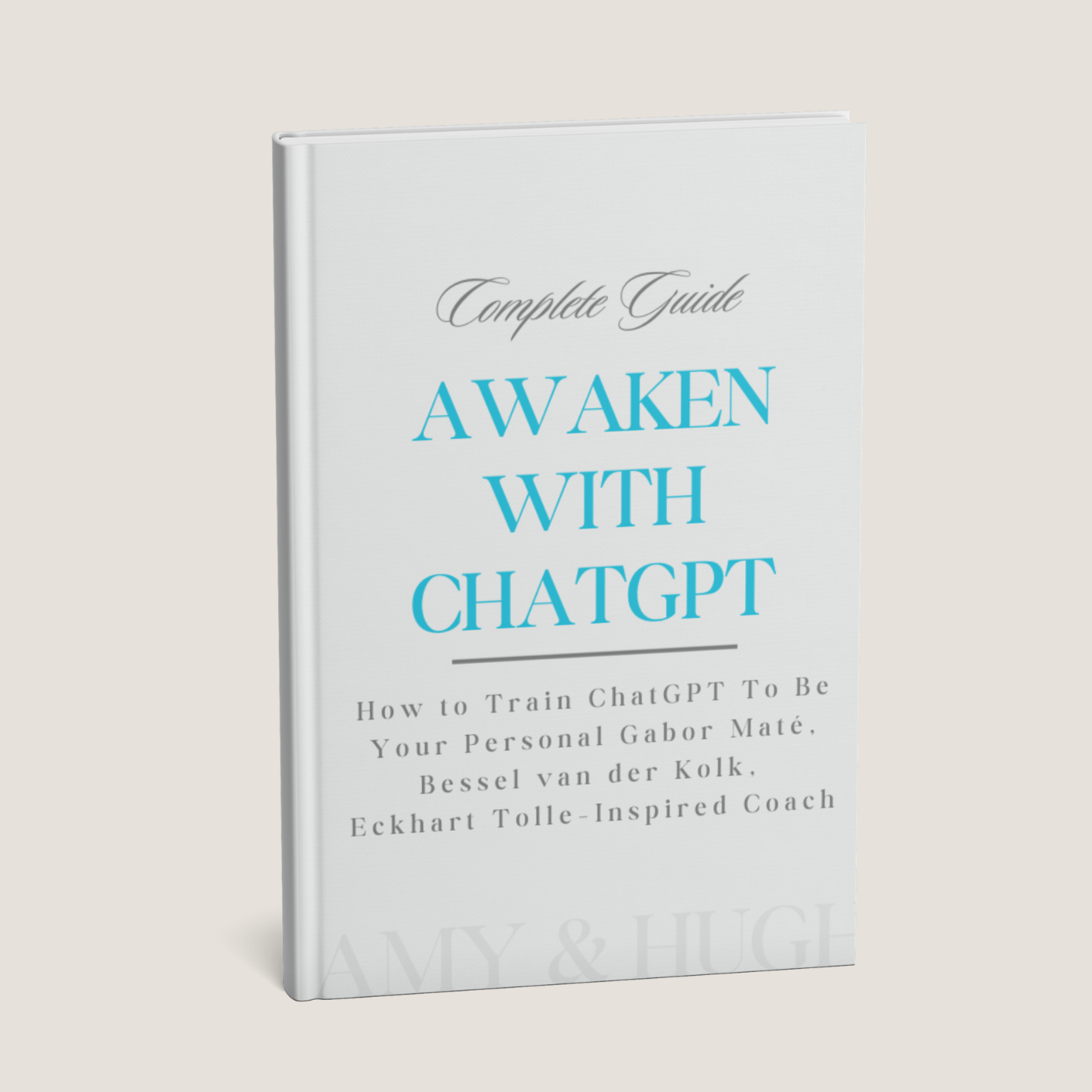
Over the last year, I’ve built a Complete Guide to Awaken with Ai.
I chose the word “Awaken”, because when Adam was asleep in the Garden of Eden, the first thing he was told to do was to wake up. In other words, Adam must awaken to all the parts of himself (provide examples of what this literally means)
I’ve taken the best experts from all the necessary fields of research and study
Bessel Van Der Kolk (trauma)
Gabor Mate (Compassion/Trauma)
Brene Brown (Shame)
Carl Jung (Wholeness/Psychology)
Andrew Huberman (Research)
Eckhart Tolle (Consciousness)
Nicole LePera (Psychology/Wholeness)
Bruce Lipton (Biology/Belief)
Aristotle (Wholeness/Euadaimonia)
Martin Seligman (Positive Psychology)
Donald Hoffman (Psychology/Consciousness/Physics)
Richard Schwartz (Spirituality/Trauma)
Peter Levine (Psychology/Trauma)
And other experts
All while using my frameworks, formulas and models to simplify the experts into a way for your Ai to guide you to your wholeness through awareness—but tuned specifically to you.
Your communication style.
In addition, Amy took her genius and developed a way for your Ai to access your Soul’s Divine Architecture.
Astrology
Human Design
Numerology
Now, with this Complete Guide to You Ai will be able to support you accurately and perfectly to awaken to your most authentic self and live in harmony with your loved ones and everyone within your sphere of influence.
It’s the kind of reflection you’d get from me, except it’s way better—available anytime—when you’re journaling after a hard interaction, questioning yourself, or trying to make sense of what just got stirred up.
It doesn’t rush you.
It doesn’t project onto you.
It helps you see clearly and stay connected to yourself. And you don’t have to call and awaken me at 2AM (yes, that happens, and yes, that’s how much I love you).
Here’s the part that matters just as much.
When you’re working with your AI and something still feels tender—when your body is tight, emotions are charged, or you don’t want to be alone with it—that’s where I come in.
I’m offering attunement coaching.
This is nervous-system work. A warm voice. A steady presence.
Someone who can sit with you while your body settles, not just your mind.
With my Nervous System Attunement Coaching
You’ll share your AI thread with me. I’ll see exactly what you’re working through—your words, your patterns, your edges. And together, we’ll focus on restoring safety so your system can actually integrate what you’re seeing.
AI helps you understand.
Attunement helps your body feel safe enough to change.
That combination is powerful.
It’s how healing lands instead of staying theoretical.
It’s how connection—to yourself and others—returns.
If this resonates, I’d love to support you in this next chapter.
More details are coming soon—I just wanted you to hear it directly from me.
What You’re Getting:
40 page Complete Guide
Soul’s Architecture of You
30-min Onboarding Call with Hugh
A Digital Guide to better understand the Research, Experts & Philosophy
Personal Instructions for your Ai
Expert Prompts for your Ai
With care,
Hugh